

The Story
Discover the artist behind the work and explore past exhibitions, creative milestones, and the story behind their artistic journey.
MEET Josama
ARTIST · PAINTER · WORLD BUILDER
Josama’s work examines the psychological, spiritual, and environmental conditions shaping contemporary life through a visual language rooted in diasporic memory, Afrofuturism, urban mythology, and speculative world-building. Working primarily in painting, he constructs alternate realities that blur the boundaries between ancestral memory, lived experience, and imagined futures.
Born in the Dominican Republic and raised in New York City amid the transformative cultural shifts of the 1980s and 1990s, Josama’s artistic framework was shaped by the visual and sonic ecosystems of Hip-Hop culture, graffiti, street iconography, music, and the layered social realities of urban life. His early engagement with graffiti established an enduring relationship to gesture, scale, rhythm, improvisation, and coded symbolism—elements that continue to influence his understanding of public space, identity, and resistance.
ROOTED IN THE CITY
TOXICITY → TRANSCENDENCE
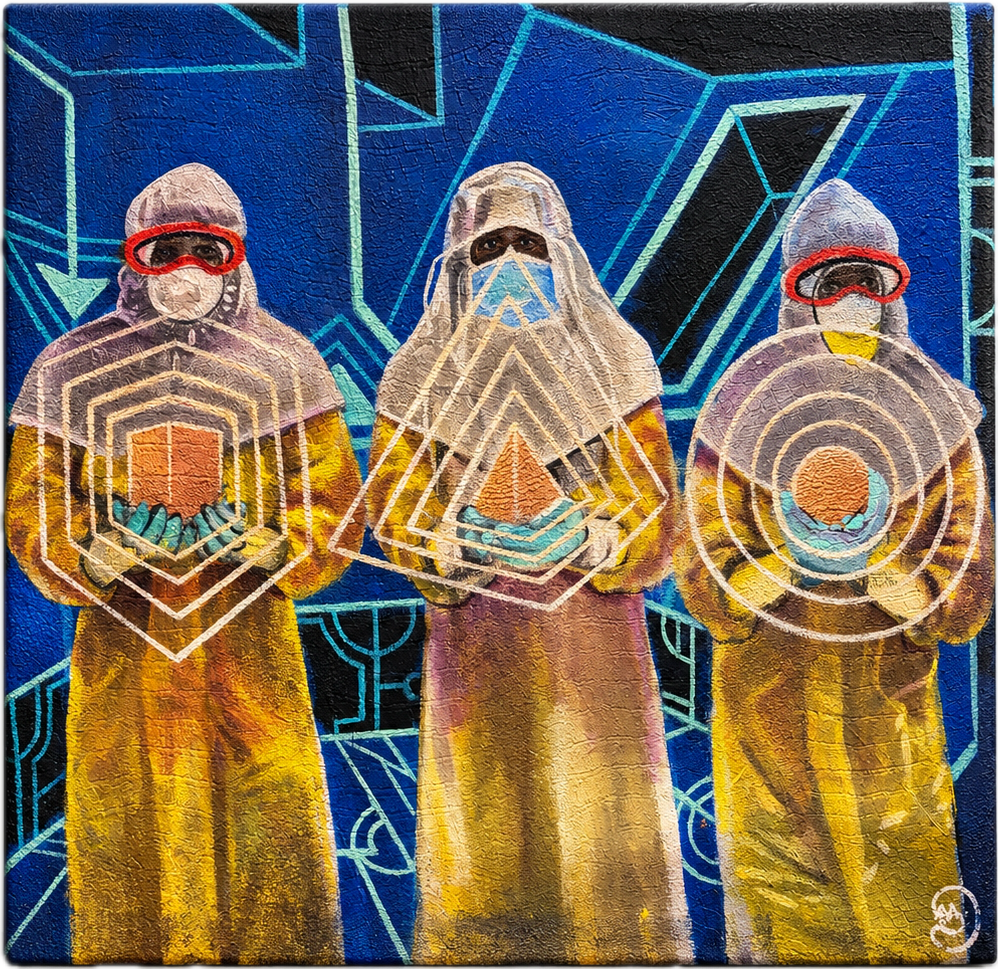
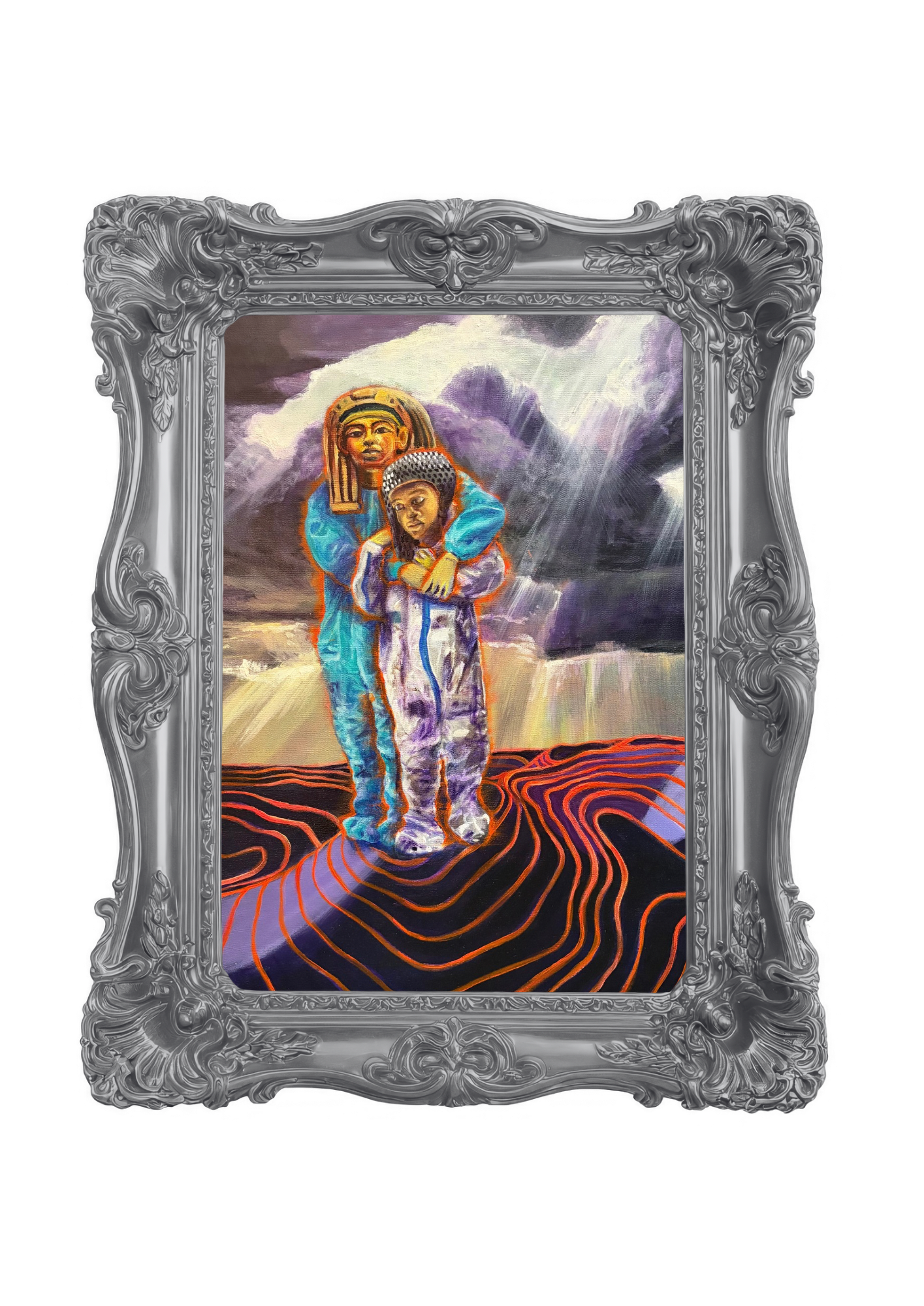
Central to Josama’s practice is the tension between toxicity and transcendence. Across his work, figures occupy psychologically charged landscapes suspended between collapse and transformation. Hazmat suits recur as symbolic devices representing psychic protection, environmental critique, inherited trauma, survival mechanisms, and spiritual armor. These forms simultaneously evoke contamination and resilience, functioning as metaphors for navigating racialized, political, emotional, and ecological instability within modern society.
As Josama Explains:
“The figures in my paintings are not simply characters.”
“They are witnesses. Survivors. Deities. Psychological fragments. Future ancestors. The hazmat suit became one of my recurring symbols because we’re all navigating contamination—socially, spiritually, environmentally, emotionally. The suit represents protection, but it also represents fear. Isolation. Adaptation. Evolution.”
THE VISUAL ARCHIVE
Josama’s paintings draw from an expansive visual archive that includes Renaissance painting, Mexican muralism, science fiction and science fact, Kemetic symbology, Indigenous cosmologies, comic books, music culture, religious symbolism, street photography, and contemporary media. Through this convergence of influences, Josama creates layered narratives where sacred archetypes coexist with pop-cultural fragments, dystopian environments, and spiritual entities.
SPECULATIVE LIBERATION
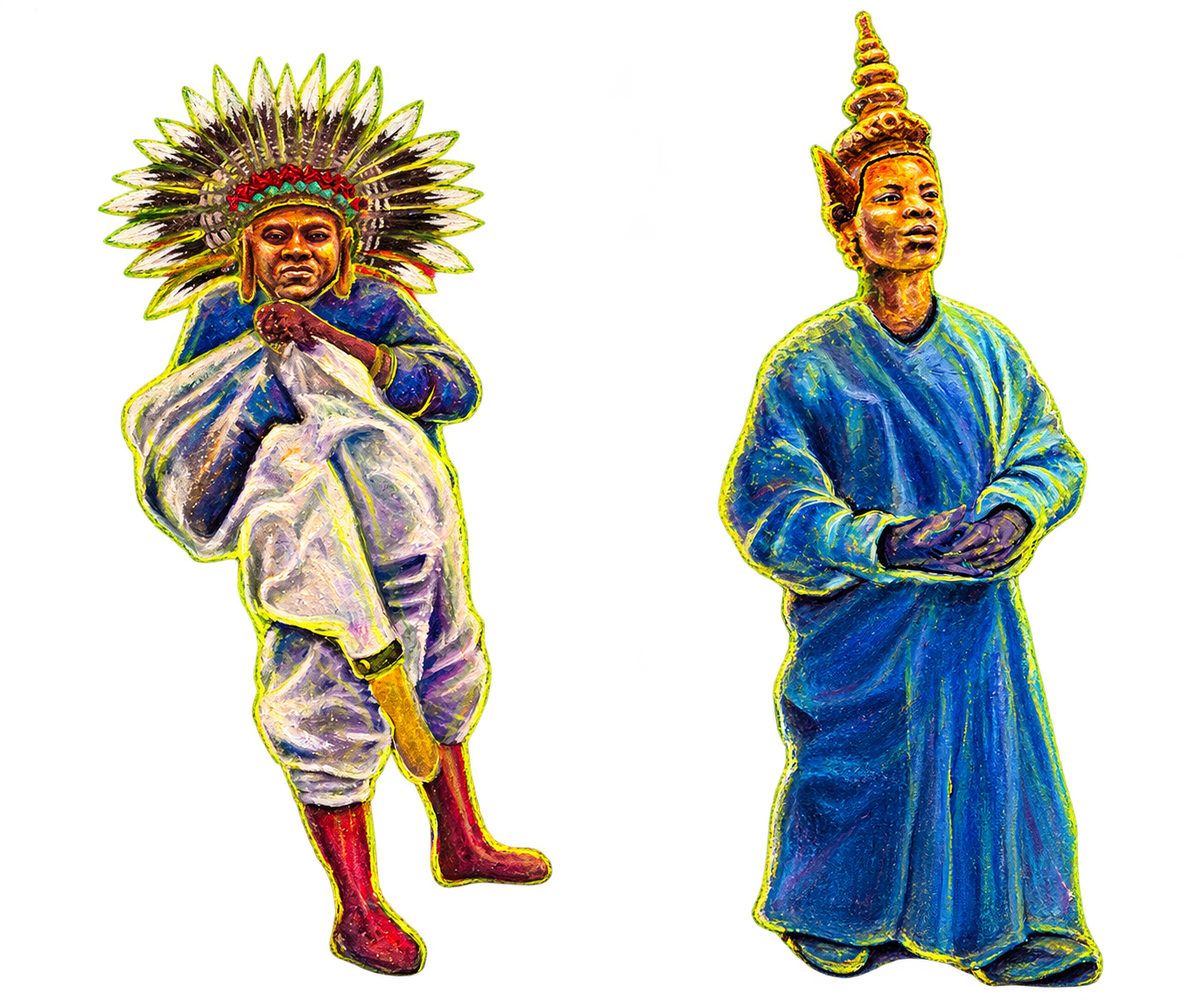
In recent years, Josama’s work has expanded into explorations of Afrofuturism and Indigenous deity systems, investigating how mythological and ancestral frameworks can operate as tools for speculative liberation. Rather than positioning futurism as technological escapism, Josama approaches alternate realities as psychological and spiritual interventions—spaces where marginalized histories, fractured identities, and collective memory can be reconstructed beyond colonial narratives and social conditioning.
TRANSFORMATION
At its core, Josama’s practice is concerned with transformation: the transformation of pain into mythology, survival into power, memory into architecture, and fragmented histories into speculative futures. His paintings function as portals where spirituality, psychology, street culture, and ancestral imagination converge to question how we define identity, protection, humanity, and liberation within an increasingly unstable world.
ZEP TEPI ZEMI
(Artist Statement)
“ZEP TEPI ZEMI is an artistic philosophy and visual language that draws inspiration from ancient Kemetic (Egyptian) cosmology, mythology, and spirituality, fused with the ancestral traditions of the Taíno-Arawak peoples of the Caribbean.
Zep Tepi translates to “The First Time”—the sacred age of creation in ancient Kemet, when the Neteru (deities) walked among humanity and established the foundations of civilization. Zemi refers to a spiritual force or ancestral presence within Taíno culture, embodying both divine and ancestral energies.
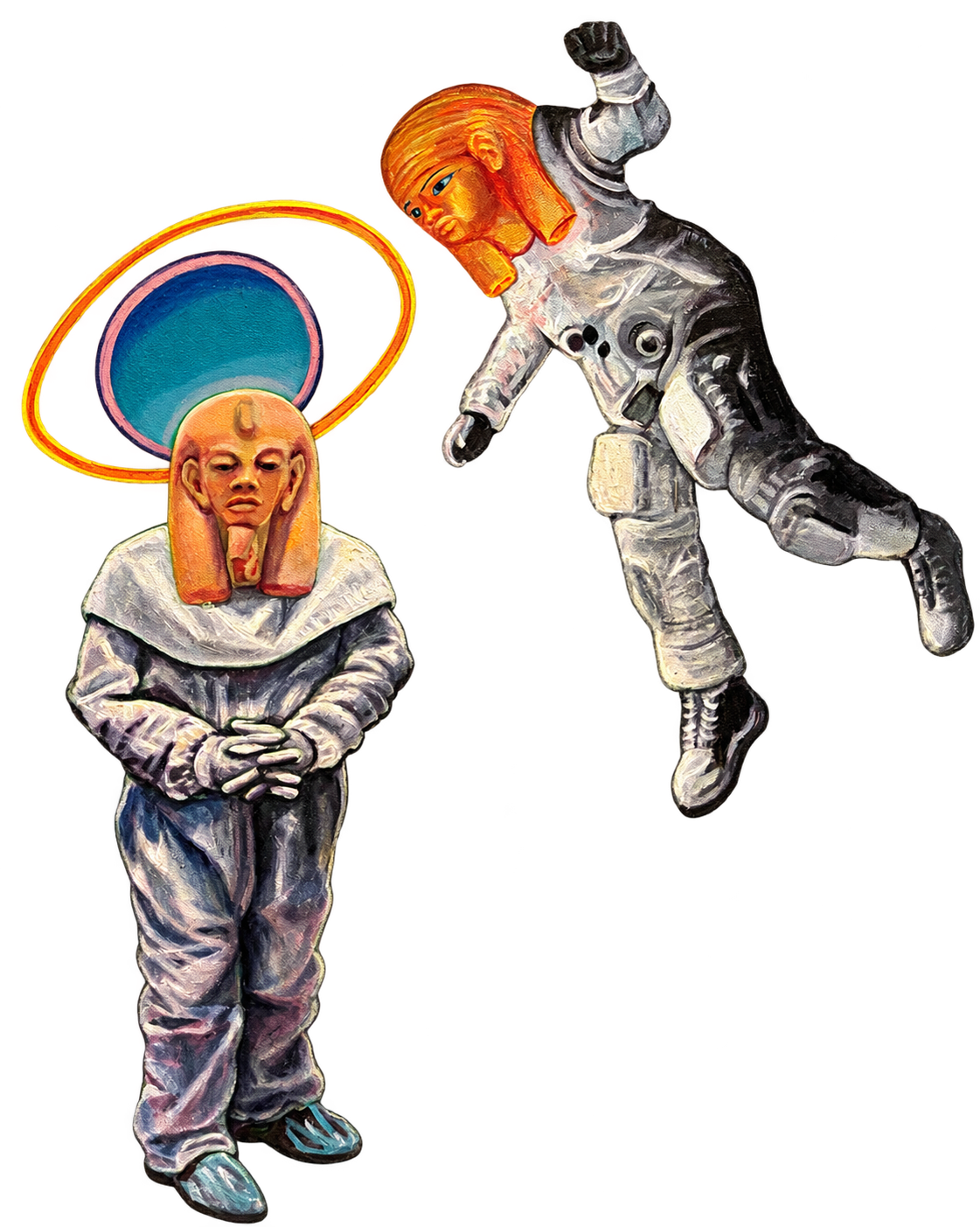
Inspired by these traditions, I began painting the Neteru—elemental forces and deities—wearing hazmat suits and existing within both familiar and imagined landscapes. These figures occupy worlds that transcend past, present, and future, illuminated by colors and energies that exist beyond ordinary perception.
Through my artwork, I seek to honor this timeless and mystical energy while exploring universal themes of transformation, rebirth, ancestral memory, and spiritual awakening. My paintings, music, and creative journey are infused with the mystery of ZEP TEPI ZEMI, inviting viewers to move beyond conventional boundaries of time and space and reconnect with the divine essence that exists within us all.
As a visual artist, my work has evolved through several distinct stages of growth and self-discovery.
From 2008–2014, my work was rooted in a darker exploration of pop culture iconography and street life. These pieces reflected the loss of innocence that occurs when a child enters adulthood and confronts the harsh realities of the world.
From 2015–2019, I entered what I call my Hazmat Era. During this period, I became fascinated with the image of the hazmat suit. The suit represented a cocoon—a protective shell through which I explored personal transformation on mental, physical, and spiritual levels. My figures appeared fully concealed within these suits, moving through fantastical environments ranging from natural landscapes and urban street corners to crumbling Egyptian ruins.
Then came 2020, when the world itself entered a kind of collective cocoon. It was during this period that my current body of work, ZEP TEPI ZEMI, fully emerged.
The hazmat suits remain, but now the faces are revealed. The figures have become ancestral spirits, gradually emerging from their protective shells and stepping into transformed realities. They inhabit fantastical worlds infused with ancient wisdom, futuristic possibility, and spiritual transcendence.
Threaded throughout every phase of my work is another enduring influence: TRON.
The original 1982 film left a profound impression on me as a child and remains one of my earliest and most powerful creative memories. Its vision of a human consciousness entering a digital world resonates deeply with my ongoing exploration of reality, identity, and spiritual existence. The concept of living within simulations—worlds nested within worlds—continues to inform my artistic practice.
ZEP TEPI ZEMI TRON represents the convergence of these influences: ancient memory, ancestral wisdom, spiritual transformation, technology, and the infinite layers of consciousness.
Welcome to ZEP TEPI ZEMI TRON.”
EXHIBITIONS
-
2017
“InfoStation,” Studio17, Bushwick, NY, winter 2017
-
2015
“Inside Stories,” Rio2 Gallery, Harlem, NY, Spring 2015
-
2012
“Unveiling Maya,” Spin, NY, winter 2012
-
2011
“Fuk U Pay Me,” 3rdEyesolation, Bushwick, fall 2011
-
2010
“EyeConcept,” Collective Conscious, Dumbo, fall 2010
“Loss of Innocence,” Black Ink, Harlem, NY, spring 2010
-
2009
“Galleria Chavon,” Casa Del Campo, D.R., spring 2009
“Pop Is Dead,” Bo-Concepts, Soho, fall 2009
-
2008
“La Caja De Yo,” Santo Domingo, D.R., winter 2008